Bear Archery
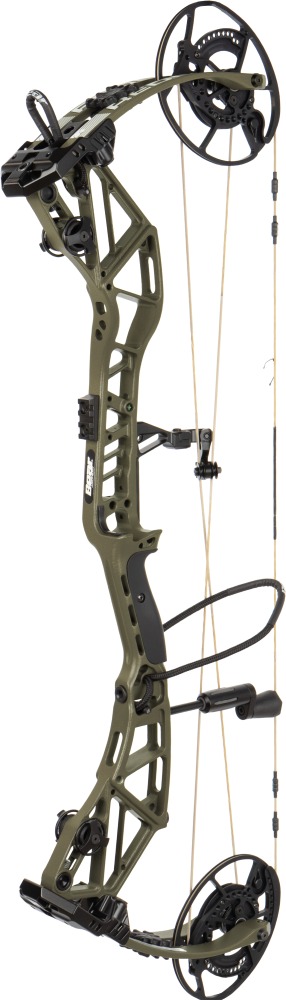
Bear Redeem
The Redeem replaces the Persist 33 as Bear's 2026 flagship, and it is the brand's most serious run yet at the Mathews/Hoyt tier: a 30-inch, 340 fps IBO platform with the EKO2 cam, a diagonally pivoting roller cable guide that ArcheryTalk owners credit for a genuinely buttery draw, and QPC quad-pocket rockers that micro-adjust limb loading for tuning. Reviewers at Grand View Outdoors and Bowhunter Planet found it exceptionally stable for a 30-inch bow, holding well even in wind. The honest problems: at a measured 4.89 pounds bare it is the heaviest bow in its class — nearly a full pound over an ARC 30 — Grand View noted buzz in the grip and string twang out of the box, and the recurring ArcheryTalk gripe is that at $1,299 Bear priced it "almost as much as a Lift" when the brand's traditional edge was value. Draw weight comes in adjustable 45–60 and 55–70 lb ranges rather than discrete peak weights, which suits shooters who de-tune or build up more than 80-pound speed chasers. It is USA-made, with Bear's typically excellent factory grip.
Specifications
Highlights
Pros
- ✓Notably stable hold for a 30" ATA bow — reviewers singled it out in windy conditions
- ✓Pivoting roller cable guard delivers a smooth, low-friction draw cycle
- ✓QPC quad-pocket rockers add real limb-pocket tuning adjustability
- ✓Adjustable 45–60 / 55–70 lb ranges suit shooters who change draw weight over time
- ✓Integrated rest mount and rope-attachment point keep the rig clean
- ✓USA-made with one of the best factory grips per ArcheryTalk regulars
- ✓$100–$300 cheaper than comparable Mathews and Hoyt flagships
Cons
- ✗4.89 lb measured bare weight — heaviest bow in the flagship class
- ✗Out-of-box grip buzz and string twang noted by reviewers; no factory silencers
- ✗ArcheryTalk sentiment says it's overpriced for the Bear badge at $1,299
- ✗No 80 lb or discrete high-poundage limb option
- ✗Dropped the second grip option the Persist 33 included
Owner Insightssummarized from ArcheryTalk, Reddit, and owner reviews
The Redeem is Bear's most serious run yet at the Mathews/Hoyt tier — a 30-inch, 340 fps flagship with the new EKO2 cam, a pivoting roller cable guard, and quad-pocket limb tuning. The interesting thing about its reception is the split: reviewers at Grand View and Bowhunter Planet came away impressed with how balanced and stable it is, while the long ArcheryTalk thread on it spent most of its energy arguing about the $1,299 price. Almost nobody says it shoots badly. Plenty of people say Bear's whole identity was value, and pricing a Bear within sight of a Mathews Lift makes the badge a harder sell.
In hand, the consensus is that the draw is where the engineering shows — the diagonally pivoting roller guard cuts friction and the EKO2 cycle is smooth into a firm wall, with 80/85% letoff switchable on the cam without a press. It holds exceptionally well for a 30-inch bow, including in wind, which is not something short-ATA bows usually get praised for. The honest knocks: it's the heaviest flagship of the year at nearly 4.9 lb measured, and out of the box there's a bit of grip buzz and string twang that wants a stabilizer and silencers Bear doesn't include. The slim flattened grip divides opinion mildly — most like it, one reviewer found it bulky for his hand.
This is a treestand and blind whitetail bow for someone who wants flagship stability without quite paying Mathews money — and who doesn't count ounces, because the mass that makes it hold so well is real. Against the Elite Varos at the same $1,299, the Varos has the accuracy hardware (and the Bow of the Year trophy); the Redeem counters with a smoother draw and that planted, wind-proof hold. It's dealer-exclusive through Bear's Legend Series program, so you'll be buying it in person.
What owners like
- +Notably stable at full draw for a 30" bow — reviewers specifically called out how well it held in wind
- +The diagonally pivoting roller cable guard gives the draw a genuinely smooth, low-friction feel
- +QPC quad-pocket rockers bring real limb-pocket micro-tuning to a Bear for the first time
- +Noticeably quieter than past Bear flagships thanks to limb isolation and improved riser acoustics
- +Adjustable 45–60 and 55–70 lb limb ranges suit shooters who move poundage around season to season
- +USA-made
- +Integrated rest mount and rope-attachment point keep the rig clean
- +$1,299 still lands under comparable Mathews and Hoyt builds
Common complaints
- −At a measured ~4.9 lb bare it's the heaviest bow in the flagship class — nearly a full pound over a Mathews ARC 30
- −Buzz in the grip and string twang out of the box; reviewers say a stabilizer and silencers fix it, but they're not included
- −The loudest ArcheryTalk complaint isn't the bow, it's the price — the recurring take was that it would fly off shelves at $899
- −Bear doesn't publish mass weight anywhere, which the forum noticed and didn't love
- −No discrete 80 lb option — tops out at 70
- −Dropped the second grip option the Persist 33 included
- −Dealer-exclusive as part of Bear's Legend Series, so you can't price-shop it online
Common Questions
What draw length range does the Bear Redeem cover?
Why do people say the Redeem is overpriced?
How heavy is the Bear Redeem?
Does the Redeem need silencing accessories?
Is the Redeem dealer-only?
Bear Redeem vs Elite Varos — same price, which one?
Compare the Bear Redeem
Related bows
More from Bear Archery →
Bear Archery
Bear Archery Take-Down
This is Fred Bear's own 1969 latch takedown, still built with the signature heel-down horn grip and still commanding heirloom money — about $750 for the riser and $470 for limbs, or roughly $1,220 complete at 3Rivers. Instead of ILF hardware it uses Bear's proprietary flush latch system: pop the lever, seat the limb, done, with no bolts to lose. The A riser builds a 56-60" bow with #1-#3 limbs; the B riser builds 60-64", letting one set of Dymondwood/Fascor-core limbs serve multiple lengths. Forum consensus (TradTalk, ArcheryTalk, Rokslide) is that these draw remarkably smoothly — owners report no stack past 29" — and they're fast and quiet with the heavy arrows a hunter should shoot anyway. Criticisms are real too: some latches develop small clicks and pops, and value opinions run about 50/50 given that $500 ILF setups shoot as well on paper. You're partly paying for Michigan-bred history, the bubinga and black maple woodwork, and limbs up to 70 lb, which almost no modern takedown offers. For traditional bowhunters who want the bow Fred himself hunted with, nothing else scratches the itch.
Bear Archery
Bear Kodiak (1959 Model)
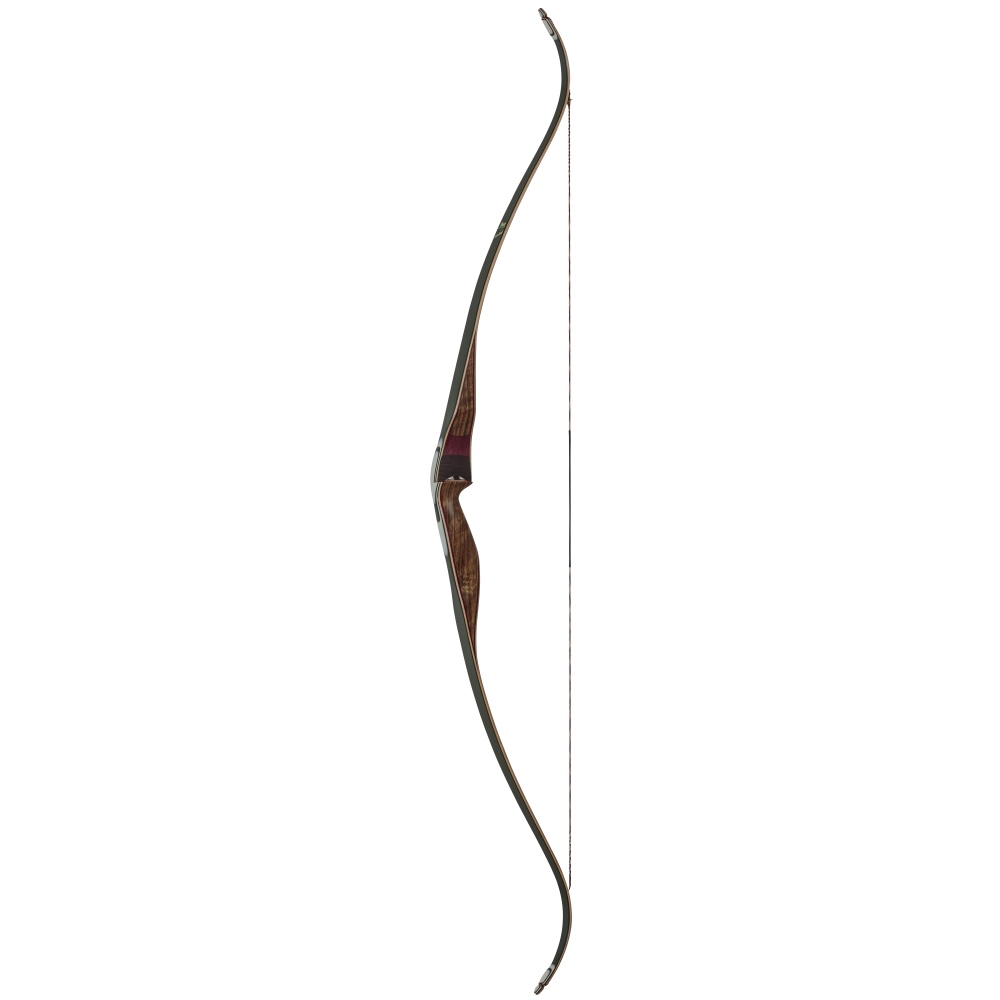
The 1959 Kodiak is arguably the most iconic recurve ever made — the bow that put Bear Archery on every bowhunter's wall and became Fred Bear's own choice after its launch. Bear's modern recreation, introduced for the model's 60th anniversary and still in the catalog in 2026, reproduces the look faithfully: a shedua riser with a purple heart I-beam running through it, green-and-white glass accents, maple-core limbs under Grayling-green fiberglass, and the signature feather arrow rest on a crowned, cut-on-center shelf with leather side plate. It's built in Gainesville, Florida and ships with a Dynaflight 97 Flemish string. On Trad Talk and Tradgang, owners praise it as smooth, quiet, and genuinely nimble for a 60-inch bow, with several comparing it favorably against semi-customs like the Toelke Chinook; the main gripes are the $730 price — Bear's most expensive one-piece — and scattered quality-control reports (finish blemishes, glass cracks) that Bear's customer service reportedly handles well. It carries 7 reviews at 3Rivers with no displayed average. If the Grizzly is the workhorse and the Super Kodiak the flagship, this is the heirloom: a hunting-ready piece of archery history rather than a budget tool.

Bear Archery
Bear Super Kodiak
Introduced in 1967 to succeed the original Kodiak, the Super Kodiak was Fred Bear's personal hunting bow for the last decades of his life — the bow in most of the famous photos from his later African and Alaskan hunts. That pedigree still drives its reputation: on Tradgang and ArcheryTalk it's routinely described as the smoothest-drawing production Bear, with a longer 60-inch AMO length that forgives sloppy releases and suits draws out to 29-30 inches better than the Grizzly. The two-piece shedua riser carries a black accent stripe and a full, palm-filling grip, and the crowned, cut-on-center shelf with bear hair rest and leather side plate shoots clean off the shelf. Unlike the Grizzly, its layered black-and-white glass tips take the included Dynaflight 97 Flemish string, so you get a modern low-stretch string's extra speed and quieter shot from the factory. The 3Rivers listing has accumulated 66 customer reviews, though no numeric average is displayed. Knocks are few: it costs $130 more than a Grizzly, left-hand weights are thin, and purists note today's Gainesville-made bow isn't hand-shaped like a Grayling original. As a do-everything hunting recurve, it's the flagship of Bear's one-piece line.
Bear Archery
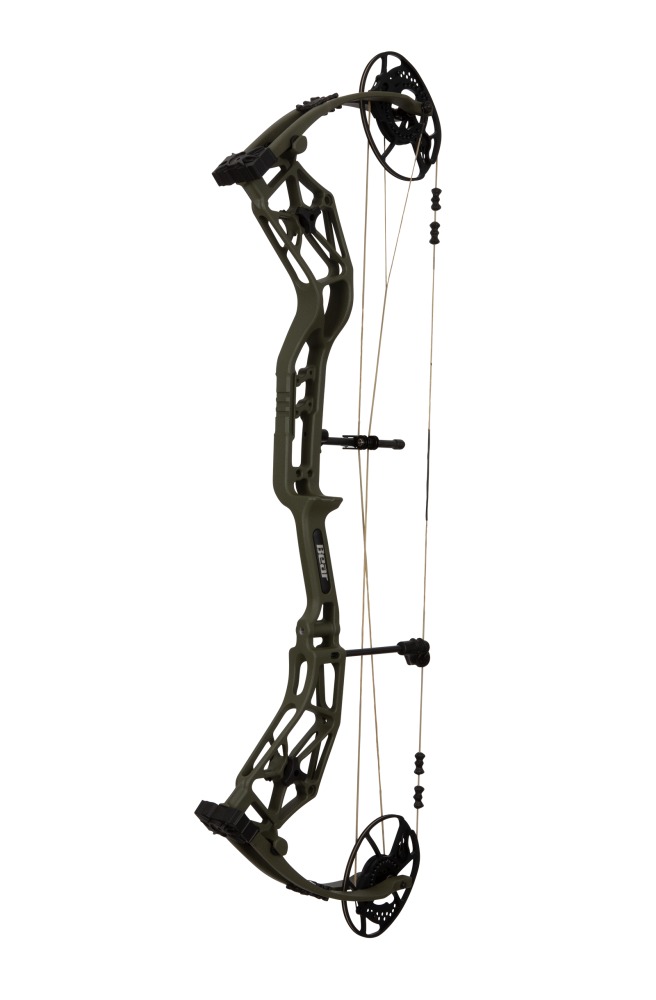
Bear Alaskan XT
Bear's Alaskan XT is the value pick of this class if you want flagship-adjacent features without a flagship bill. The price shown is the common Ready-to-Hunt package street price (about $600 at Walmart; $679.99 direct from Bear), which includes a Trophy Ridge 4-pin sight, Whisker Biscuit, quiver, stabilizer, peep and D-loop; the bare bow runs around $500-530. The spec sheet punches up: 33-inch axle-to-axle for stable aiming, 335 fps ATA from the DHC-XR cam system, an integrated Picatinny sight mount, roller cable guard, and a light 3.5 lb bare weight. ArcheryTalk threads titled 'now that's value' capture the sentiment - most owners report a surprisingly smooth draw and tight groups, and it holds 5.0/5 across 10 Pyramyd Air reviews plus 4.8/5 at Walmart. Honest knocks: there is a quick buzz at the shot that the KillerWave dampeners don't fully kill (one owner found it livelier than Bear's own Whitetail Maxx), the 25-30 inch draw range excludes very short and long-draw shooters, and the RTH accessories are entry grade - most serious hunters upgrade the sight and rest within a season.
Bear Archery
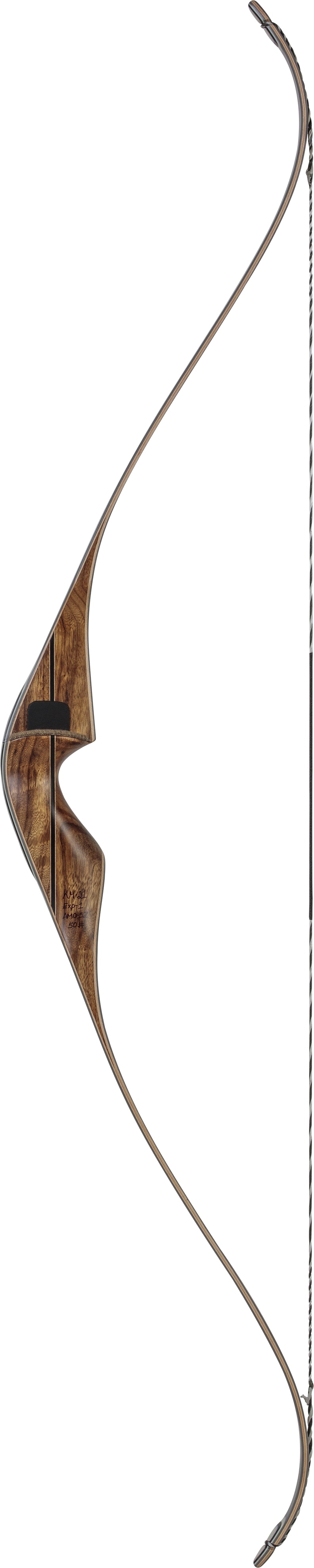
Bear Kodiak Magnum
The Kodiak Magnum first appeared in 1961 as the treestand and brush hunter's answer to full-length recurves, and the modern reissue keeps the formula: a heavily recurved 52-inch bow with a shedua riser, black accent stripe, and maple-core limbs faced in distinctive arctic-grey fiberglass. It is the shortest, lightest-in-hand bow in Bear's one-piece lineup, which is exactly why ground-blind and saddle hunters love it — it clears shooting rails and brush that a 60-inch bow won't. The radiused, cut-on-center shelf with bear hair rest and leather side plate shoots off the shelf, and the layered tips take the included Dynaflight 97 string. The honest trade-offs are well documented on ArcheryTalk and Tradgang: at 52 inches the string angle gets steep, so shooters past about 28 inches of draw report finger pinch and noticeable stacking, and many shoot it three-under to ease nock pinch. Its light mass also makes it less forgiving to aim than heavier bows. It carries 13 reviews at 3Rivers with no displayed average, and as of August 2026 stock is spotty — sold out at Bear's site with a waitlist at 3Rivers. For short-draw hunters in tight quarters, nothing in the Bear catalog is handier.
Bear Archery
Bear Montana
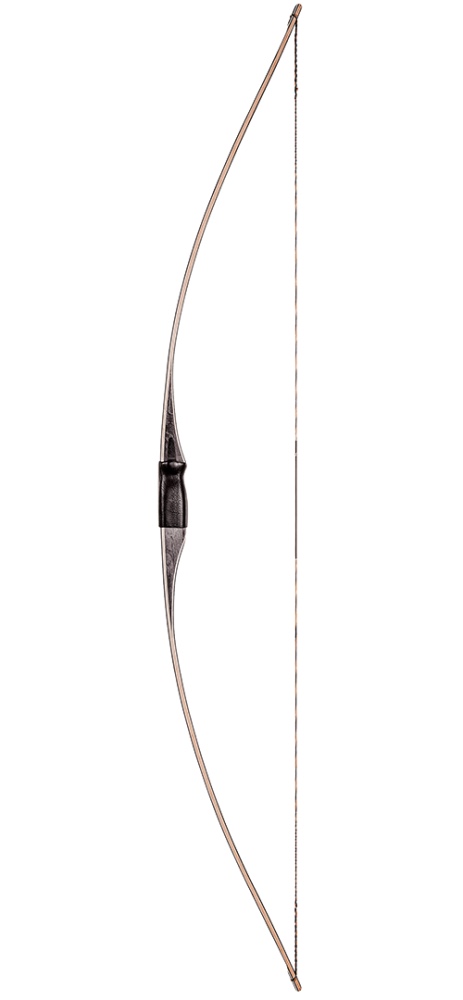
In the Bear lineup since the late 1990s, the Montana is the longbow most American trad hunters start with — a 64-inch, slightly reflexed D-shape design with a hard-rock maple riser, white maple limbs under black or grey fiberglass, and a supple leather grip with matching leather shelf rug and side plate for shooting off the shelf. The slight reflex and tapered limb laminations give it more zip than a straight-limbed Hill-style bow, and the 64-inch length keeps finger pinch and stacking away for draws up to about 29 inches. Lancaster calls it a longbow that 'performs well above its price-point,' and Amazon buyers rate it 4.4/5. Community feedback on ArcheryTalk and Trad Talk is largely positive but honest about longbow realities: there is some hand shock — mild by longbow standards, and mostly tamed with a properly tuned brace height, heavier arrows, and the included Dynaflight 97 string — and the sight window is not cut past center, so arrow spine selection matters more than on Bear's recurves. At $460-530 street it undercuts custom longbows by hundreds while delivering a genuinely huntable, quiet, lightweight package that carries all day.