Draw Weight for Hunting: What You Actually Need
Draw weight is where ego meets physics and ego usually loses. The internet will tell you that you need 70 pounds; your state's regulations say something like 35; the truth is that a 40 lb compound with a sharp broadhead through the ribs kills a whitetail as dead as anything, and the hunter who can't hold his draw weight steady in a cold treestand wounds deer that a lighter bow would have killed. Here's how to pick a number honestly.
Legal floors, practical answers
| Game | Typical legal minimum | Practical recommendation |
|---|---|---|
| Whitetail / mule deer | 35-45 lb (varies by state) | 45-60 lb compound; 45+ lb trad |
| Elk | 40-50 lb (several states set 50) | 60-70 lb compound; 50+ lb trad |
| Black bear | 40-50 lb | 55-70 lb compound; 50+ lb trad |
| Moose | 50 lb where specified | 65-70 lb compound; 55+ lb trad |
| Turkey / small game | Usually same as deer | Whatever you shoot most accurately |
Check your state's actual regulations — minimums range from no stated floor to 50 lb for elk, and a few states regulate momentum or arrow weight instead. But notice how low the legal floors are: wildlife agencies set them where clean kills are demonstrably possible. A modern compound at 45 lb launching a 420-grain arrow will shoot completely through a broadside whitetail at 20 yards. The gap between 'legal minimum' and 'what the guy at the pro shop bought' is mostly margin — and margin is genuinely worth having for quartering angles, heavy bone, and elk — but it only counts if you can shoot it well.
Trad hunters should treat 40 lb at their draw length as the ethical floor for deer, and note the phrase at your draw length: limbs are rated at 28 inches, and a recurve gains or loses roughly 2-3 lb per inch of draw. A 45 lb Sage drawn to 26 inches is really a 40 lb bow, which is exactly why the spec sheet fine print matters more in trad than anywhere else.
The overbowed epidemic
The most common equipment mistake in bowhunting isn't a cheap bow — it's 10 extra pounds of draw weight. The tell is the sky-draw: bow arm pointed at the treetops, whole upper body heaving to break the cams over. That draw motion is a deer-spooking flag in the woods, and it gets worse everywhere it matters: after two motionless hours at 20°F, muscles that barely managed the weight at the summer range simply won't, quietly, from a seated position with a buck ten yards away.
The field test is simple and non-negotiable: sit flat on the ground, point the bow straight at the target, and draw with the pin staying on target the whole way — no sky, no grunt, no shoulder roll. Do it ten times. If rep ten looks like rep one, the weight is yours; if not, back the limbs off or buy lighter. Ego says 70; the deer genuinely cannot tell the difference between being killed by 55 and 70; your shot placement can. And placement is the entire game — a 45 lb bow through the lungs beats a 70 lb bow in the shoulder every single time.
Compound shooters have an escape hatch trad shooters don't: limb bolts. Most compounds adjust down 10 lb from peak (and the beginner-class bows adjust much further), so buy the bow that fits at its mid-range, hunt it a season at a comfortable weight, and crank it up as you get stronger. Maxed-out limb bolts on a first bow are a warning sign, not a flex.
Why 45 trad pounds feels like 65 compound pounds
The numbers aren't comparable across bow types, and the difference is let-off. A 65 lb compound at 85% let-off has you holding about 10 lb while you aim; a 45 lb recurve has you holding all 45 while your subconscious runs the aiming program. Trad shooting is closer to a strength-endurance sport, which is why trad hunters run 15-20 lb less than their compound number and why the learn-light-hunt-heavy limb progression exists. If you're crossing over from compound, resist the urge to match your old peak weight — buy the takedown, get 30 lb learning limbs and 45 lb hunting limbs, and let your shoulders vote.
Bows mentioned in this guide
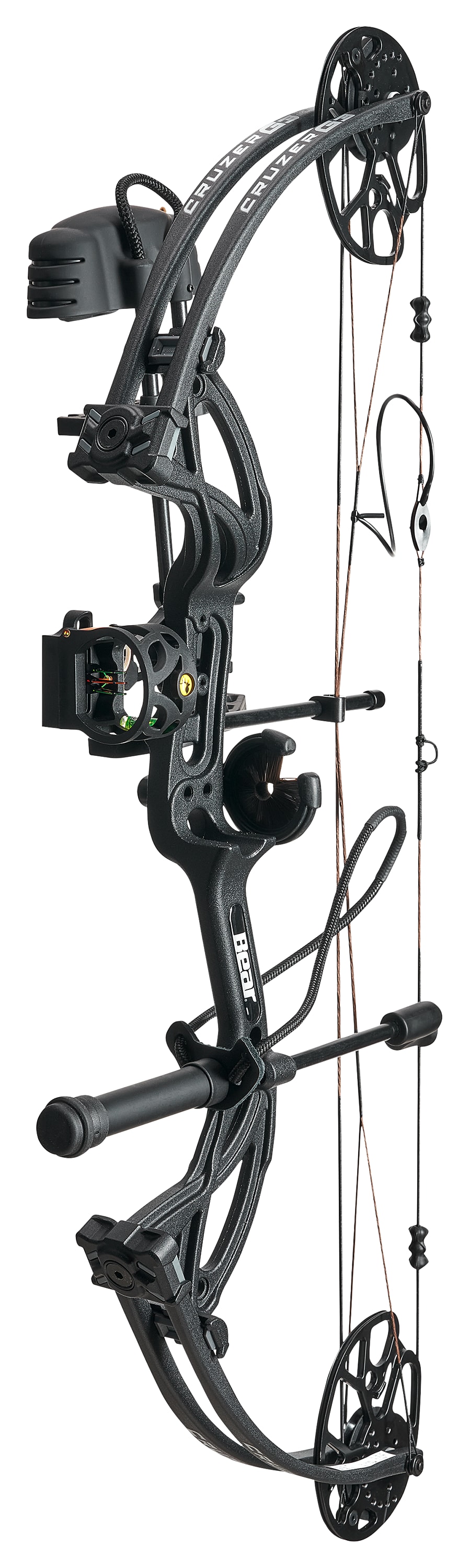
Bear Archery
Bear Cruzer G3
The Cruzer line is the perennial rival to Diamond's Edge series, and the G3 is the fastest of the ultra-adjustables here: a dual-cam system pushing 315 fps with 10-70 pounds and 14-30 inches of adjustment, all Allen-wrench accessible. It sells as a Ready-to-Hunt package - Trophy Ridge 4-pin sight, Whisker Biscuit V, 5-Spot quiver, 6-inch stabilizer, factory-installed peep and D-loop - for roughly $350-500 depending on finish; $449 is the common price point at big-box retailers. Note that Bear released the Cruzer G4 in 2025 ($419-460, near-identical adjustability on a 29-inch frame), so the G3 is late in its retail life but still widely stocked. Testers and owners describe the draw as pleasant for a two-cam bow at hunting weights, with an honest caveat: the back wall is slightly mushy and the G3 runs a touch louder and buzzier than single-cam budget rivals - the price of its extra speed. The 3-pound bare mass is great for young shooters carrying it but amplifies hand feel. Trophy Ridge accessories are a cut above most bundled kits, and the whole package is legitimately huntable out of the box.

Samick
Samick Sage
For over a decade, "just buy a Samick Sage" was the reflexive r/Archery answer to every beginner question, and the cult status is earned: a hard-maple riser, fiberglass-laminated limbs, threaded bushings for a sight, plunger, quiver, and stabilizer, and a proprietary bolt-on limb pattern with the cheapest, most available replacement limbs in traditional archery. That limb ecosystem is the Sage's superpower for hunters — start at 25-35 lb to learn form, then swap to 45 or 50 lb limbs for around $70-90 instead of buying a new bow. It is not ILF, so you're locked to Sage-pattern limbs, but clones and spares are everywhere. Samick's global distribution has wobbled in recent years; Southland Archery Supply now produces and sells it for about $110, while Amazon third-party listings drift up toward $160, and the original design team went on to found Southwest Archery, whose Spyder is essentially the Sage 2.0. At 62" AMO it suits draws up to about 29". Thousands of deer have fallen to 45-55 lb Sages; it remains the benchmark budget hunting takedown.
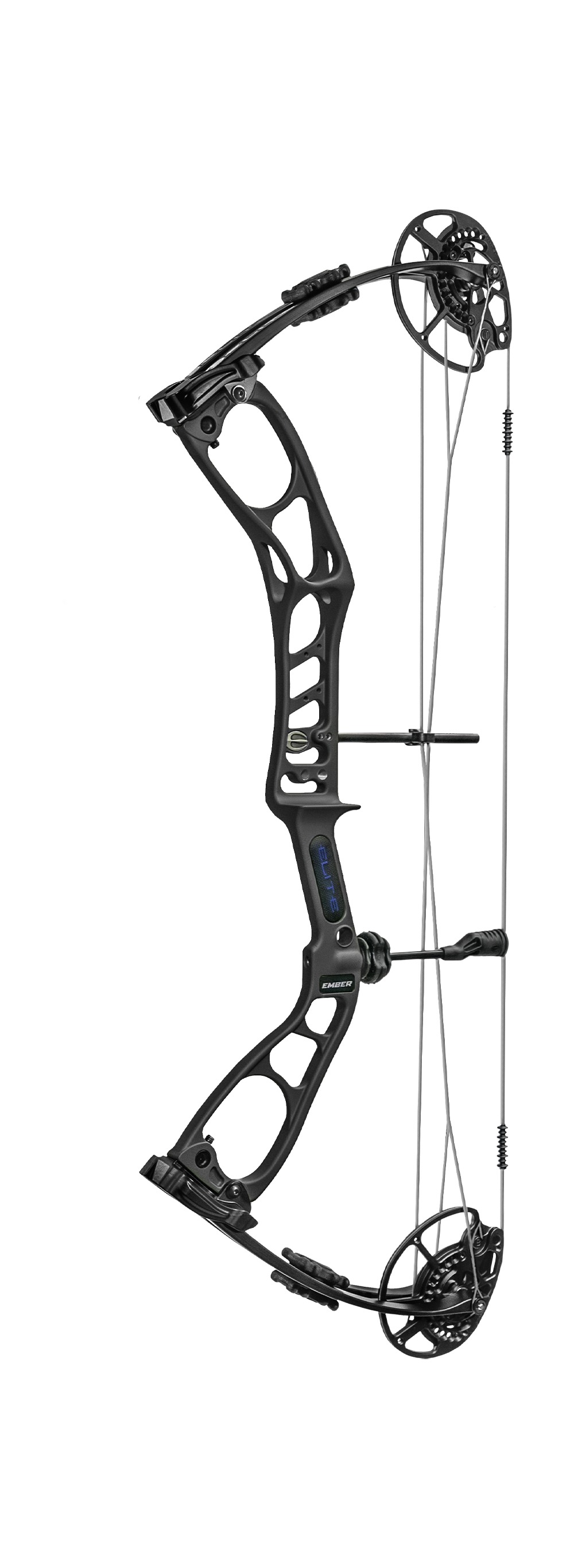
Elite Archery
Elite Ember
The Ember is Elite's do-everything adjustable bow, and unlike most sub-$700 packages it comes from a brand better known for $1,200 flagships like the Era and Artus. The $679.99 price is for the RTS package (sold that way by Elite direct and Scheels), which bundles a CBE Tactic 3-pin sight, Arrow Mane capture rest, stabilizer, quiver and Winner's Choice strings - meaningfully nicer package parts than the Trophy Ridge or Octane kits rivals bolt on. With 10-60 lb of draw weight and 15-29 inches of draw length, it fits nearly anyone, which is why ArcheryTalk regulars call it one of the best grow-with-you buys; several report it out-holds and out-feels the Bear Legit and PSE Stinger head-to-head, with a limb-stop back wall that is unusually solid for the class. Real knocks: 310 fps IBO is modest and short-draw speeds are pedestrian; the dual-cam-with-yokes system needs occasional re-syncing where binary-cam rivals (Amplify, Deploy SB) hold tune longer; and a minority find the light 3.6 lb bare bow slightly nervous at full draw. Versus Elite's own flagships you give up SET tuning, speed and shot quietness - but not fit and finish.