Compound vs Recurve for Hunting: The Honest Version
Every archery forum gets this thread weekly, and the honest answer is less diplomatic than the replies: if the goal is venison, buy a compound. If the goal is the experience, a recurve is one of the most rewarding hard things you can take up — and it will cost you range, opportunities, and probably a season or two. Both are true at once. Here's what each choice actually asks of you, so you pick the hard path on purpose rather than by accident.
What let-off actually changes
A compound's cams do something no traditional bow can: after you pull through the peak weight, the cams roll over and you hold a fraction of it — 75-90% less on modern hunting bows. Holding 9 pounds instead of 65 changes everything about how the weapon hunts. You can draw when the buck is still 60 yards out and hold for a full minute while he closes; you can aim through a pin sight with the bow essentially parked at full draw; you can let a rangefinder and a 30-yard pin do the trajectory math. The bow is doing real work for you, and that work converts directly into ethical shots you couldn't otherwise take.
A recurve gives you none of that. At full draw you're holding every pound of the limbs, which means you draw when the moment is right and shoot within about two seconds — draw, anchor, loose, one motion. There's no sight on most hunting setups; aiming is a trained subconscious skill (call it instinctive, gap, or string-walking, the arguments are eternal) that only exists if you've built it with thousands of arrows. None of this is a flaw. It's the entire point: the recurve makes the shot yours in a way a compound never quite does. But be clear-eyed that you're buying a skill commitment, not just a simpler tool.
The proficiency timeline nobody puts on the box
A new compound shooter with a properly fitted bow, a release aid, and a couple of coached range sessions is typically grouping well enough to hunt at 20-30 yards within two or three months of regular practice. The equipment is doing what it was designed to do — the let-off holds the weight, the peep and pins handle the aiming, the release beats finger flaws. Plenty of people buy a compound in July and ethically kill a deer in November, and nobody serious considers that reckless.
The trad timeline is different in kind, not just degree. Consistent accuracy with a recurve is a body skill like a golf swing — form, anchor, back tension, and release have to become automatic, and they only get there through frequent, ideally daily, practice over something like a year. The universal beginner mistake is buying too much draw weight and learning flinches instead of form: the standing advice on every trad forum is to learn on 25-35 lb limbs and buy heavier hunting limbs later (this is exactly why takedown recurves dominate the category). If 'shoot most days' doesn't describe a commitment you'll keep, that's not a character flaw — it's a compound purchase decision.
Effective range: the number that decides hunts
A practiced compound hunter's honest range on deer is 30-40 yards, with fit western shooters stretching further on elk-sized targets. A practiced trad hunter's honest range is 15-20 yards. That's not equipment snobbery — arrows from a 45 lb recurve arrive slower and with more arc, and without a sight, precision degrades fast past 20. Halving your radius quarters your huntable area: the trad hunter needs deer nearly on top of the stand, which means better scouting, better wind discipline, and more empty sits. Trad hunters will tell you those constraints made them better woodsmen. They're right, and it's still the reason trad success rates are a fraction of compound rates.
There's also the moment-of-truth difference. A compound at full draw is a stable, mostly-held-for-you aiming platform — buck fever has a mechanical ally. A recurve shot happens in one two-second window with your muscles under full load, which is exactly when adrenaline does its worst work. The trad remedy is the same as everything else in trad: volume of practice until the shot runs on rails regardless of your heart rate.
The case for the hard path anyway
After all that, trad archery keeps growing, and the people who switch rarely switch back. The reasons are real: a bare recurve weighs half what a rigged compound does and carries all day without a sling; there is nothing to go out of tune, no cam timing, no peep rotation, no batteries; a $170 Samick Sage with fresh limbs shoots the same in year ten as year one. Practice is genuinely fun in a way compound practice often isn't — flinging arrows at stumps is a hobby in itself, and many trad converts report shooting ten times more arrows simply because they want to. And the fifteen-yard kill, when it finally happens, is by every account a different order of experience.
The pragmatic answer a lot of hunters land on: both, in sequence. Hunt a compound while you build trad skills on the side — a takedown recurve makes the second bow cheap — and take the recurve to the woods the season your practice says you've earned it. Nothing about the choice is permanent, and the used market makes experimentation nearly free.
The verdict
Buy a compound if you want to hunt effectively this season, if your practice time is a few sessions a month, or if a 30-yard shot matters where you hunt. Buy a recurve if the process is the point, you'll genuinely shoot several times a week, and you accept that success will be rarer and closer. Whichever you choose, spend the difference on arrows and practice — the shooter behind the bow decides more hunts than anything in this catalog.
Bows mentioned in this guide
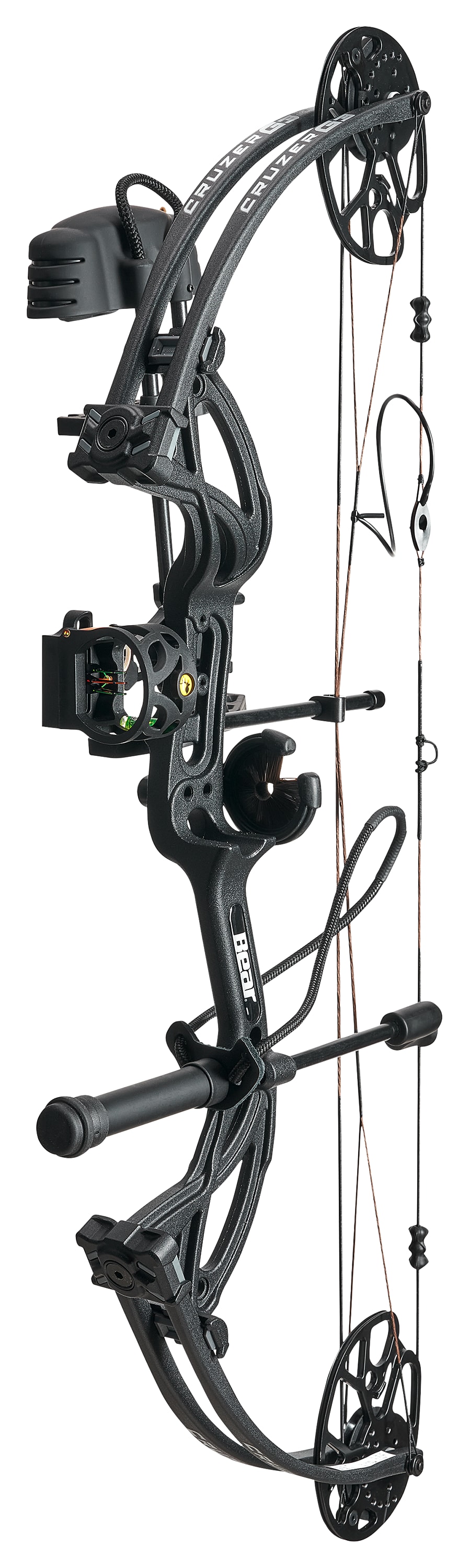
Bear Archery
Bear Cruzer G3
The Cruzer line is the perennial rival to Diamond's Edge series, and the G3 is the fastest of the ultra-adjustables here: a dual-cam system pushing 315 fps with 10-70 pounds and 14-30 inches of adjustment, all Allen-wrench accessible. It sells as a Ready-to-Hunt package - Trophy Ridge 4-pin sight, Whisker Biscuit V, 5-Spot quiver, 6-inch stabilizer, factory-installed peep and D-loop - for roughly $350-500 depending on finish; $449 is the common price point at big-box retailers. Note that Bear released the Cruzer G4 in 2025 ($419-460, near-identical adjustability on a 29-inch frame), so the G3 is late in its retail life but still widely stocked. Testers and owners describe the draw as pleasant for a two-cam bow at hunting weights, with an honest caveat: the back wall is slightly mushy and the G3 runs a touch louder and buzzier than single-cam budget rivals - the price of its extra speed. The 3-pound bare mass is great for young shooters carrying it but amplifies hand feel. Trophy Ridge accessories are a cut above most bundled kits, and the whole package is legitimately huntable out of the box.
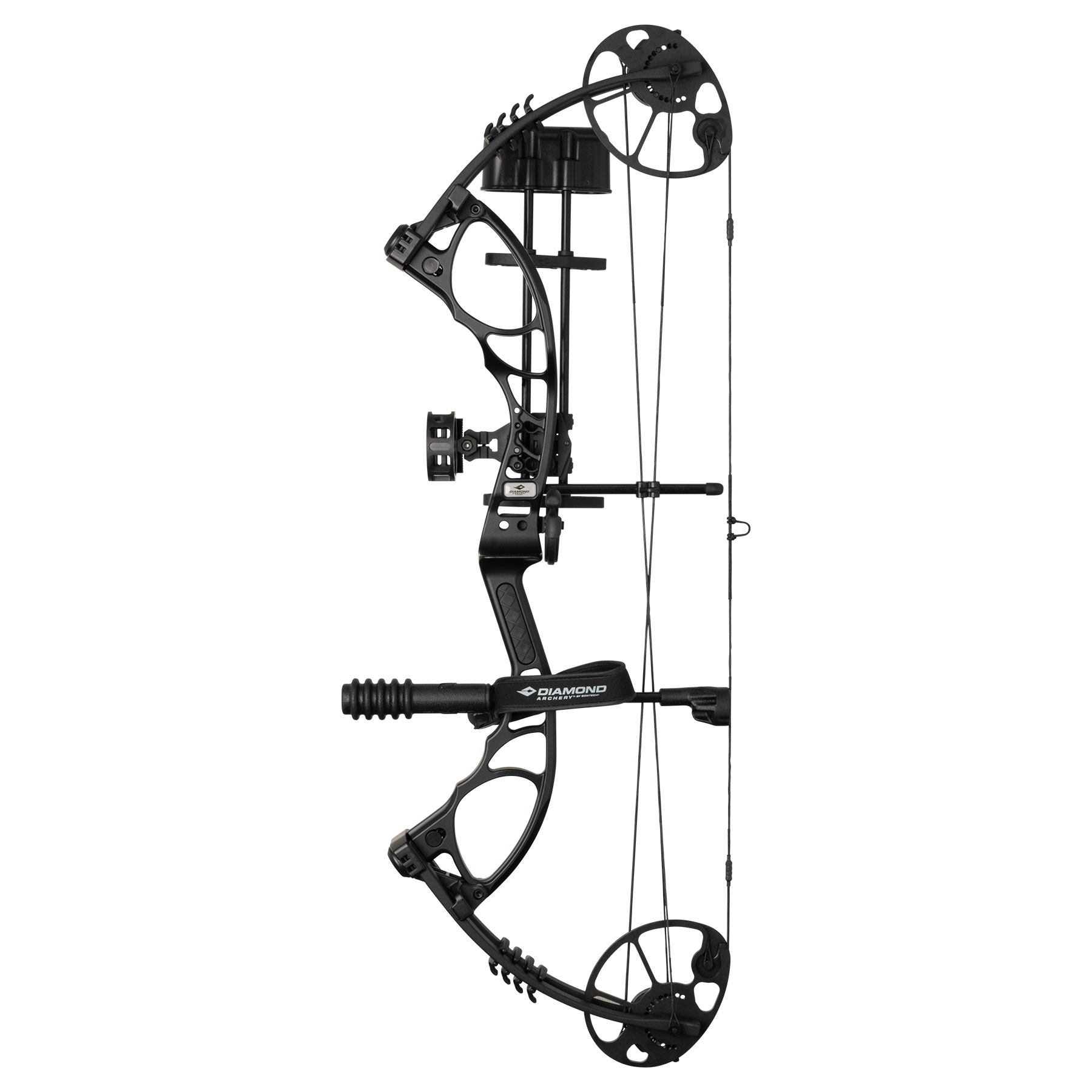
Diamond Archery
Diamond Edge XT
The Edge XT is the bow budget shoppers get pointed to when they insist on buying new instead of used: a Bowtech-built platform with a caged riser and ultra-wide quad limbs, sold as a complete package (3-pin Octane sight, brush rest, Furnace quiver, 5-inch stabilizer, peep, wrist sling) for about $419 street - it routinely goes on sale near $340, and $449 is Diamond's list. Rotating-module cams cover 19-31 inches of draw and 20-70 pounds with nothing but an Allen wrench, so one bow can carry a shooter from first lessons through whitetail season. The draw cycle is among the smoothest in this class - soft and unaggressive with 80 percent let-off - and the 6.75-inch brace on a 31-inch axle-to-axle frame is forgiving of sloppy form. The trade-offs are the usual budget ones: 300 fps ATA is slow next to mid-range bows, the back wall is spongier than cable-stop flagships, and the Octane accessories are serviceable rather than good - most owners upgrade the sight and stabilizer within a year. The 20-pound floor also fits teens and adults better than young kids; Diamond's Infinite and Prism go lower.

Samick
Samick Sage
For over a decade, "just buy a Samick Sage" was the reflexive r/Archery answer to every beginner question, and the cult status is earned: a hard-maple riser, fiberglass-laminated limbs, threaded bushings for a sight, plunger, quiver, and stabilizer, and a proprietary bolt-on limb pattern with the cheapest, most available replacement limbs in traditional archery. That limb ecosystem is the Sage's superpower for hunters — start at 25-35 lb to learn form, then swap to 45 or 50 lb limbs for around $70-90 instead of buying a new bow. It is not ILF, so you're locked to Sage-pattern limbs, but clones and spares are everywhere. Samick's global distribution has wobbled in recent years; Southland Archery Supply now produces and sells it for about $110, while Amazon third-party listings drift up toward $160, and the original design team went on to found Southwest Archery, whose Spyder is essentially the Sage 2.0. At 62" AMO it suits draws up to about 29". Thousands of deer have fallen to 45-55 lb Sages; it remains the benchmark budget hunting takedown.
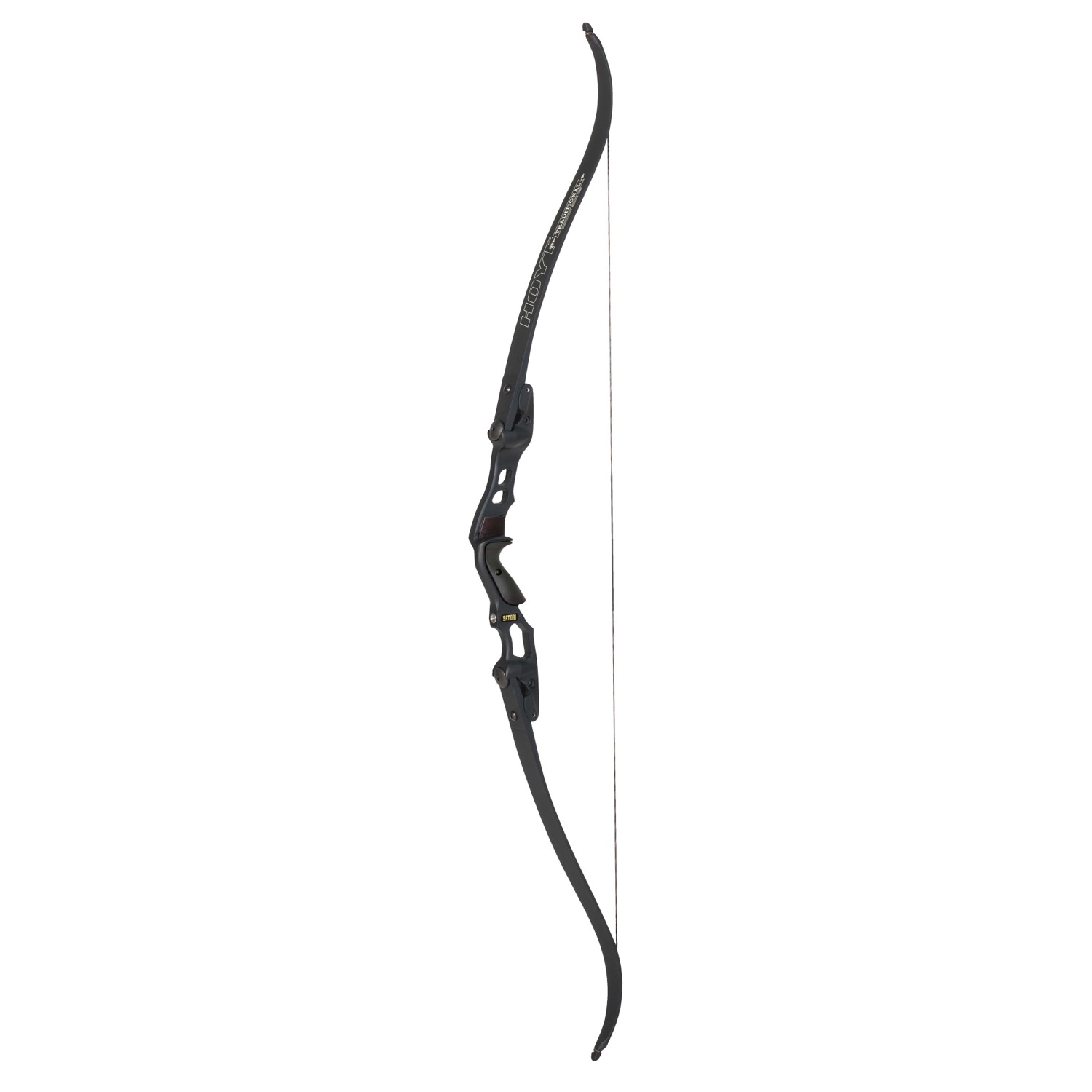
Hoyt
Hoyt Satori
The Satori is the modern benchmark for ILF hunting recurves — ArcheryTalk regulars call it "the Glock of trad bows": unglamorous, reliable, and a flat-out shooter. The machined aluminum riser comes in 17", 19", and 21" lengths (2.4 lb for the 19") with Hoyt's Grand Prix ILF pockets, micro limb alignment, and an adjustable side plate over a radiused shelf, so it tunes like a target bow but carries like a hunting rig. Because it's true ILF, you can hang Hoyt's own carbon/maple Satori limbs (35-65 lb, rated on the 21" riser) or any of hundreds of ILF limbs from $180 budget sets to $1,000 carbon-foam blades — the upgrade path is the whole sport. Complete bows run about $1,100 at 3Rivers ($520 riser + $580 limbs; watch for package deals nearer $900). Community gripes are specific: the ILF fitting can creak on a cold first draw (owners pre-draw once on stand), the metal riser is louder than wood if untuned, and there's only one rest hole. Find the quiet sweet spot around 8-8.125" brace and it's arguably the most accurate hunting recurve sold today.