What a Hunt-Ready Bow Setup Really Costs
Bow marketing quotes the bare bow price, and the bare bow can't hunt. A $1,399 flagship compound needs several hundred dollars of accessories, a dozen arrows, broadheads, and a tune before it's a weapon — meanwhile a $450 ready-to-hunt package walks out the door functional. Neither is a scam; they're different products for different buyers. Here's the real math for all three ways in: budget package, bare mid-range/flagship, and the used-market cheat code.
The accessory bill nobody quotes
| Item | Functional | Quality |
|---|---|---|
| Sight (3-5 pin) | $40-$80 | $150-$350 |
| Arrow rest (drop-away) | $40-$60 | $100-$200 |
| Release aid | $30-$50 | $100-$200 |
| Stabilizer | $25-$40 | $80-$150 |
| Quiver | $30-$50 | $70-$130 |
| 12 arrows, cut & fletched | $80-$120 | $150-$250 |
| Broadheads (6) | $40 | $60-$90 |
| Target block | $40-$60 | $100-$150 |
| Pro shop tune & peep | $0-$50 | $75-$150 |
Add it up and the honest range is $400-$700 on top of any bare bow, before a rangefinder (another $150-$300, and you genuinely need one to bowhunt unfamiliar ground). This is the number that makes first-time buyers feel ambushed at the pro shop, and it's why the right comparison isn't '$450 package vs $700 bare bow' — it's '$450 complete vs $1,200 complete'. The accessories also outlive the bow: a good sight, rest, and release migrate to your next riser, so quality there is a long-term buy in a way the bow itself isn't.
The ready-to-hunt package, defended
The Bear Cruzer G3, Diamond Edge XT, and PSE Stinger-class packages exist precisely to solve the accessory ambush: sight, rest, quiver, stabilizer, and peep installed at the factory for $400-$600 all-in. The included accessories are the honest weak point — the sights are dim, the rests are simple biscuits, the stabilizers are decorative — but they work, and the standard playbook is to hunt the package as-is for a season, then upgrade the sight and rest with money you now know you want to spend. The bows themselves are legitimately capable: hugely adjustable, plenty fast, and responsible for an enormous number of dead deer every fall.
What the package can't include is the tune and the fit. Even a boxed package benefits from a pro shop visit to set draw length, tie in a peep at your anchor, and paper-tune the rest — usually under $100 and worth every dollar. Budget it. An untuned bow throwing broadheads eight inches off from field points in November is the classic first-season disaster, and it's a $60 fix in August.
The used flagship: archery's best-kept non-secret
Compound flagships depreciate like phones: last year's $1,300 Mathews sells for $700-$900 lightly used the week the new model ships, because a loud minority of archers must own the newest thing. Their impatience is your discount — the year-over-year changes are genuinely marginal, and a three-year-old flagship still outshoots every new bow under $800. The ArcheryTalk classifieds and archery Facebook groups are the market; the safety checklist is short: inspect limbs for splinters or delamination in photos, confirm the draw length is yours or the bow uses adjustable mods, ask for a timestamp photo, and pay through purchase protection.
One honest caveat: a used bow means no warranty (most flagship warranties are original-owner-only) and it still needs the accessory bill and the tune. The math usually still wins — $800 used flagship plus $500 of good accessories beats $1,300 of anything new — but it's a path for the buyer comfortable doing a little diligence, not the buyer who wants a warranty card and a handshake.
The trad budget, for contrast
Traditional archery's entry math is almost comically gentler: a Samick Sage or Black Hunter takedown runs $130-$180, a dozen wood-or-carbon arrows $80-$150, a shooting glove and armguard $30, a stringer (non-negotiable, limbs twist without one) $15, and there's no sight, rest, release, or stabilizer to buy because the bow doesn't use them. Call it $300 hunt-capable — the catch, as always with trad, is that the missing $500 of accessories gets replaced by a year of practice. You pay either way; trad just takes it in time instead of money.
Bows mentioned in this guide
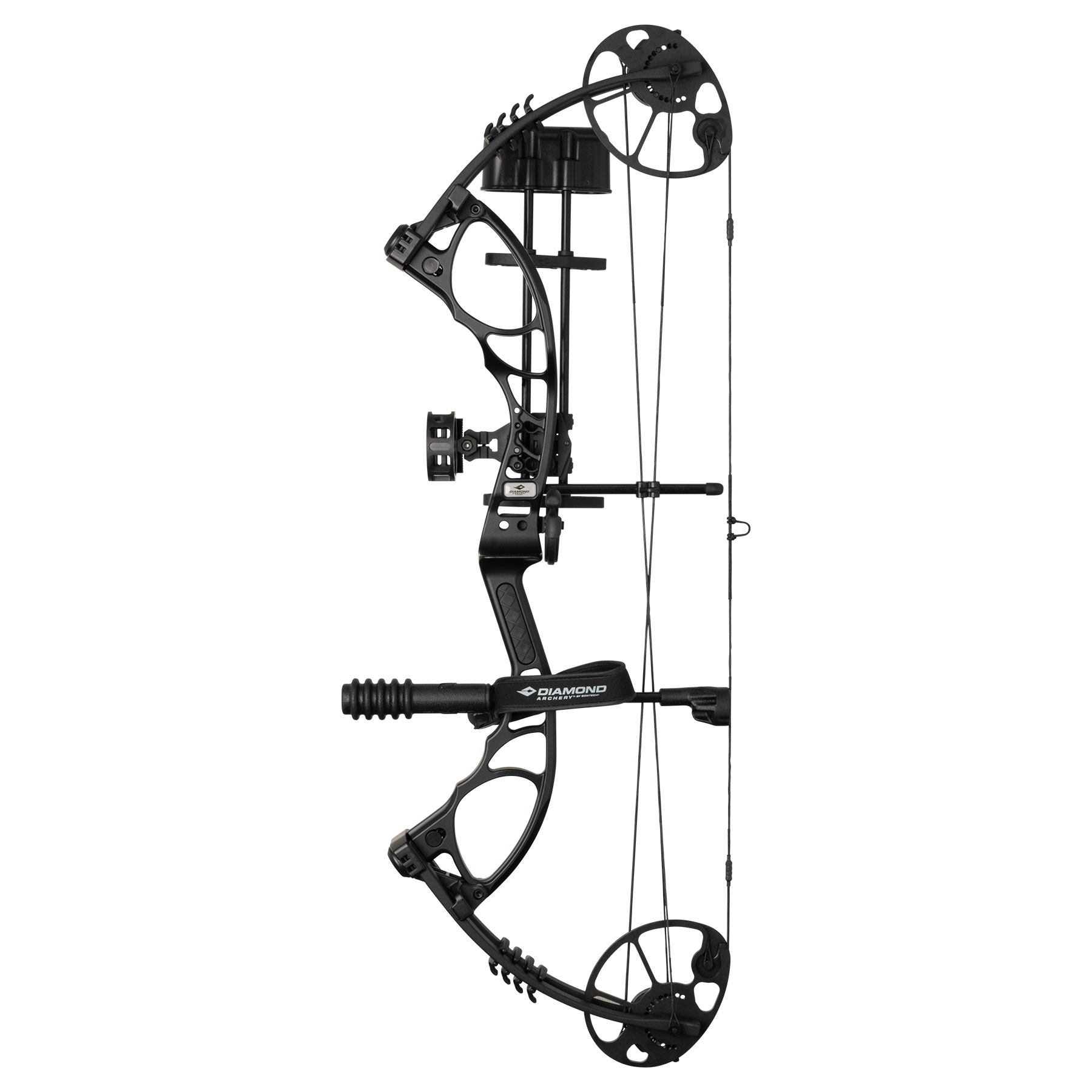
Diamond Archery
Diamond Edge XT
The Edge XT is the bow budget shoppers get pointed to when they insist on buying new instead of used: a Bowtech-built platform with a caged riser and ultra-wide quad limbs, sold as a complete package (3-pin Octane sight, brush rest, Furnace quiver, 5-inch stabilizer, peep, wrist sling) for about $419 street - it routinely goes on sale near $340, and $449 is Diamond's list. Rotating-module cams cover 19-31 inches of draw and 20-70 pounds with nothing but an Allen wrench, so one bow can carry a shooter from first lessons through whitetail season. The draw cycle is among the smoothest in this class - soft and unaggressive with 80 percent let-off - and the 6.75-inch brace on a 31-inch axle-to-axle frame is forgiving of sloppy form. The trade-offs are the usual budget ones: 300 fps ATA is slow next to mid-range bows, the back wall is spongier than cable-stop flagships, and the Octane accessories are serviceable rather than good - most owners upgrade the sight and stabilizer within a year. The 20-pound floor also fits teens and adults better than young kids; Diamond's Infinite and Prism go lower.
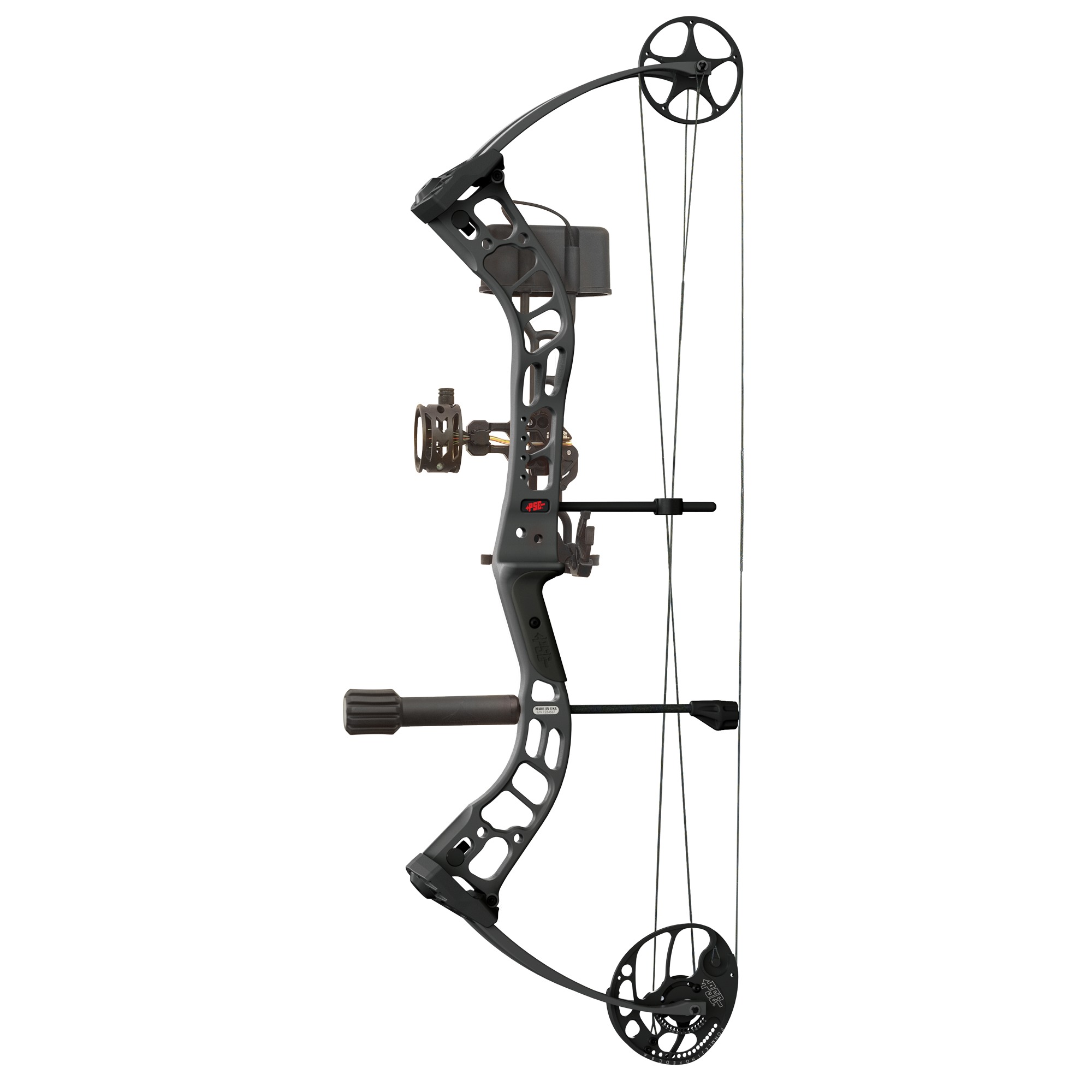
The Stinger has been PSE's budget workhorse for over 15 years, and the current ATK generation - refreshed with the wide-range 'Grow With You' SS Cam - keeps it the default recommendation for a first serious hunting rig. The price shown is the ready-to-shoot package (Sierra Lite sight, TruGlo EZ rest, Hunter Lite quiver, FX4 stabilizer, peep and loop) that typically runs $450-500; the bare SS Cam bow is $449 at Lancaster, and discounters have blown packages out in the high $300s. The ATK riser is noticeably more rigid than the old Stinger Max platform, the 32-inch axle-to-axle and 6-5/8-inch brace make it forgiving, and the SS Cam covers 21.5-30 inches of draw with no bow press. ArcheryTalk owners routinely call it the best bow in its price range - quiet, low-vibration, with multiple 'killed deer with it both years' testimonials. The trade-offs are honest ones: 312 fps is slow next to the 335 fps Alaskan XT and Amplify, 4.0 lb mass is porky for the class, the package accessories are bare-bones, and grip and finish feel a tier below the Elite Ember. As a durable, tunable do-everything platform, it is hard to beat at the price.
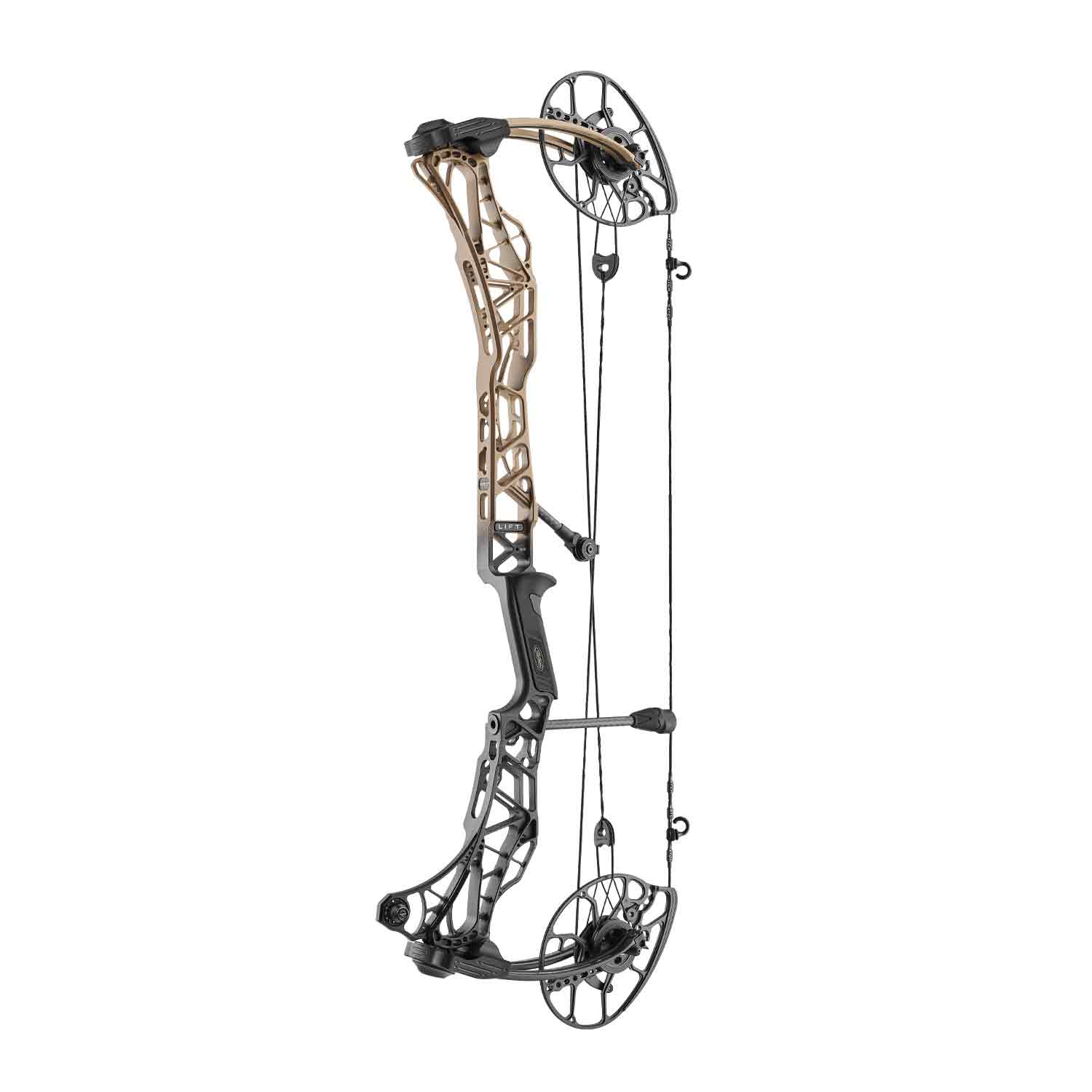
Mathews
Mathews Lift X 29.5
Mathews' 2025 flagship is still on dealer racks, and now that the ARC series has replaced it, closeout pricing makes it the sleeper buy of this list — Scheels has it at $1,099, down from $1,299. On paper it's the athlete of the group: 3.99 lb bare, 348 fps IBO (the fastest-rated Mathews here), and a compact 29.5" ATA that's a treestand and blind favorite. Field & Stream measured it among the quietest bows they've tested at 67.5 dB and found it the most accurate bow in their test from 20–40 yards, and owners echo the dead-in-the-hand shot. The honest caveat is the draw: the SWX cam holds near max weight late in the cycle before dropping into a short valley, and ArcheryTalk draw-force-curve threads confirm it's more aggressive than the marketing suggests — the ARC exists partly to fix that. Limb Shift Technology handles cam-lean tuning with a wrench, no press, and the BOND grip is swappable if the stock feel isn't yours. If the price-per-performance math matters more than having the newest cam, this is the value play.

Samick
Samick Sage
For over a decade, "just buy a Samick Sage" was the reflexive r/Archery answer to every beginner question, and the cult status is earned: a hard-maple riser, fiberglass-laminated limbs, threaded bushings for a sight, plunger, quiver, and stabilizer, and a proprietary bolt-on limb pattern with the cheapest, most available replacement limbs in traditional archery. That limb ecosystem is the Sage's superpower for hunters — start at 25-35 lb to learn form, then swap to 45 or 50 lb limbs for around $70-90 instead of buying a new bow. It is not ILF, so you're locked to Sage-pattern limbs, but clones and spares are everywhere. Samick's global distribution has wobbled in recent years; Southland Archery Supply now produces and sells it for about $110, while Amazon third-party listings drift up toward $160, and the original design team went on to found Southwest Archery, whose Spyder is essentially the Sage 2.0. At 62" AMO it suits draws up to about 29". Thousands of deer have fallen to 45-55 lb Sages; it remains the benchmark budget hunting takedown.